History of Video Synthesizers, Designers, and Artists[edit]
1960s[edit]
- 1962, Lee Harrison III's ANIMAC: (Hybrid graphic animation computer) – predecessor to the Scanimate
- 1966, Dan Slater's custom vsynths: Dan Slater has built a number of custom homebrew vsynths over the years, & worked with Douglas Trumbull on various films.
- 1968, Eric Siegel's PCS (Processing Chrominance Synthesizer)
- 1968, Computer Image Corporation Scanimate:[5]
- Video of a News Report on Scanimate, including interview with inventor Lee Harrison III
- 1969, Paik/Abe synthesizer
- Built at WGBH Boston Experimental TV Center envisioned by Nam June Paik, designed by artist/engineer Shuya Abe.[6]
- Several built at CalArts, and Experimental TV Center Binghamton University, WNET NYC, Jim Wiseman has one still operational
- Click on the heading for a dedicated page, w/extensive Real Video Clips
- 1969, Bill Hearn's VIDIUM: (Analog XYZ driver/sequencer)
- 1969, Glen Southworth's CVI Quantizer & CVI Data Camera
1970–1974[edit]
- 1970, Eric Siegel's EVS Electronic Video Synthesizer & Dual Colorizer (Analog)
- 1970, groove & VAmpire
- (Generated Real-time Output Operations on Voltage-controlled Equipment)
- (Video And Music Program for Interactive Realtime Exploration/Experimentation).
- 1970, Lear Siegler's vsynth: Unique Hi-Rez video processor used in the film "Andromeda Strain" and by Douglas Trumbull & Dan Slater
- Stephen Beck's Direct Video Synth & Beck Video Weaver
- Stephen Beck created some early 70's synths that had no video inputs. They made video purely from oscillations.
- He also modified a few Paik/Abe units.
- Sherman WALTER WRIGHT: One of the first video animators, he worked at Computer Image Corp in the early 70's,
- 1971, Sandin Image Processor: Very early video synth....DIY modular, Built by Dan Sandin of Chicago.
- 1972, Rutt/Etra Video Synthesizer: Co-invented by Steve Rutt & Bill Etra, this is an analog computer for video raster manipulation.
- 1973, Phil Morton publishes "Notes on the Aesthetics of Copying an Image Processor'". He "proudly referred to himself as the ‘first copier’ of Sandin’s Image Processor. The Sandin Image Processor offered artists unprecedented abilities to create, process and affect realtime video and audio, enabling performances that literally set the stage for current realtime audio-video New Media Art."[8]
- 1974, VSYNTH's by David Jones: Many creations, the most famous being the Jones Colorizer, a four channel voltage controllable colorizer with gray level keyers.
- 1974, EMS Spectre: Innovative video synthesiser using analogue and digital techniques, developed by Richard Monkhouse at EMS. Later renamed to 'Spectron'.
1975–1979[edit]
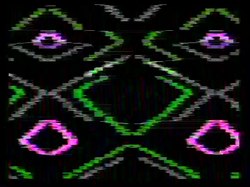
- 1975, Dave Jones Video Digitizer: an early digital video processor used for video art. It did real-time digitizing (no sample clock) and used a 4-bit ALU to create color effects
- 1975, Don McArthur's SAID: Don McArthur developed the SAID (Spatial and Intensity Digitizer), an outgrowth of research on a black and white time base corrector with Dave Jones
- 1976, Denise Gallant's vsynth: Created a very advanced analogue video synthesizer in the late 70's.
- 1976, Chromaton 14
- A fairly small analog video synthesizer, w/color quantizers & can generate complex color images without any external inputs.
- Built by BJA Systems[1]
- 1977, Jones Frame Buffer: Low resolution digital frame storage of video signals (higher resolution versions, and multi-frame versions were made in 1979 and the early 1980s)
- 1979, Chromachron: One of the first DIGITAL VSynths. – Designed by Ed Tannenbaum.
- 1979, Chromascope Video Synthesizer, PAL and NTSC versions. Created by Robin Palmer. Manufactured by Chromatronics, Essex, UK. Distribution by CEL Electronics. Model P135 (2,000 units built) and Model C.101 (100 units built).[9]
1980s[edit]
- 1984, Fairlight CVI Computer Video Instrument: The Fairlight CVI was produced in the early 80's, and is a hybrid Analog Digital video processor.[citation needed]
2000s[edit]
.jpg)
_2013-11-14_11.55.34.jpg)


- 2008, Lars Larsen and Ed Leckie founded LZX Industries and began developing new analog video synthesizer modules (Visionary, Cadet, and Expedition Series).[10]
- 2011, Critter & Guitari Video Scope: preset video synthesizer.[11]
- 2013, Critter & Guitari Rhythm Scope: preset video synthesizer.[12][failed verification]
- 2014, Critter & Guitari Black & White Video Scope: preset video synthesizer.[12][failed verification]
- 2014, Ming Mecca: modular pixel-art-oriented analog video synth[13]
- 2015, CFOGE Video Equations: procedurally generated digital video synth.[14]
- 2016, Paracosm Lumen: semi-modular software video synth for MacOS.[15]
- 2016, Vsynth: a modular software video synthesizer package for Max/Jitter.
- 2016, Ming Micro: pixel-art-oriented digital video synth[16]
- 2017, Critter & Guitari ETC: video synthesizer that supports 720p output.[17]
Comments
Post a Comment